
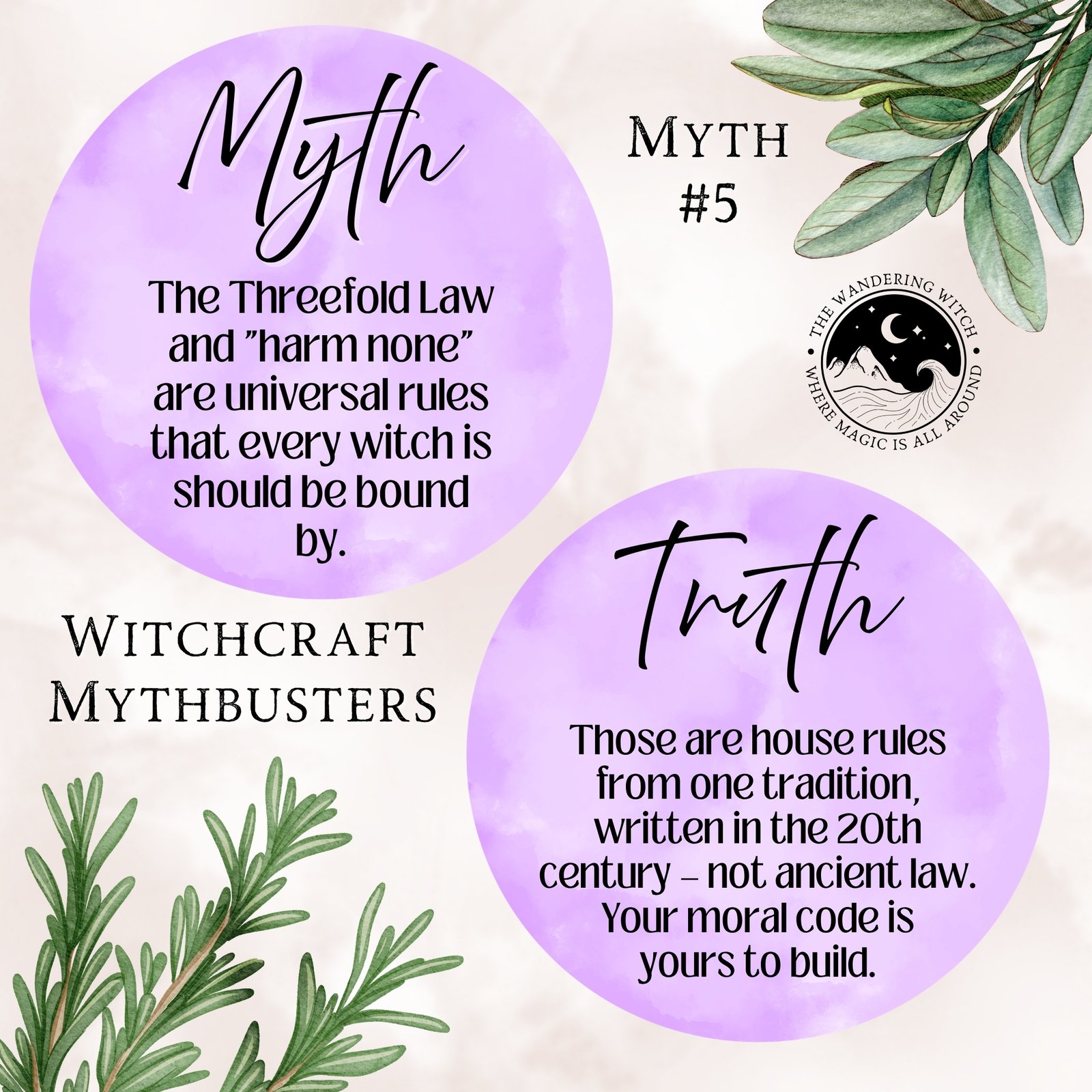
👊🏻 Witchcraft Myth-Busters 👊🏻
with Lexi
The Threefold Law: When “Morality” Becomes Spiritual Policing
MYTH: “Harm to none” and the Rule of Three are universal laws of witchcraft that every witch should abide by.
This one gets weaponized and thrown around more than almost any other belief in our community, so let’s deconstruct it.
People seem to forget that Wicca is a very modern belief system in origin. It was created in the mid 20th century in England.
Gerald Gardner wrote “do what you like as long as you harm no one” in his 1959 book “The Meaning of Witchcraft”.
The “official” Wiccan Rede – “an it harm none, do what ye will” – was first spoken publicly by Wiccan High Priestess, Doreen Valiente, in October of 1964. The 26-line version most people quote didn’t even appear in print until the mid-1970s, through Lady Gwen Thompson.
It has been picked up, repeated, and expanded on so many times that it eventually hardened into “law” through decades of books and speeches, many largely geared towards beginners in the craft.
Now, I want to be clear that there is nothing inherently wrong with the Rede. If it resonates with you, and you choose to take it on as your personal code of ethics, that’s your choice. I respect your right to do that.
Where it becomes problematic is when it is being touted as some state of moral superiority over other practices, beliefs, moral codes, and ancestral or cultural histories.
With the trendification of witchcraft on social media, we have seen these generalizations and narratives rooting into more and more corners of spirituality.
When people say things like “all real witches follow harm to none,” or “we only do white (or ‘light’) magic here” we are perpetuating systems of harm, exclusion, and discrimination in our practice. To say it is “more noble” or “moral” to operate under the idea of “harm to none” is to completely neglect and dismiss the history of folk magic and cultural practices that are rooted in the blood and grief of tragedies like chattel slavery.
It’s like saying that enslaved people who used hot foot powder against their overseers were “evil” or “demonic”.
That the Appalachian woman who buried a witch’s bottle to use against the man threatening her family was doing something shameful or morally wrong.
That every folk tradition that has ever given someone a small piece of their agency back by building protections that had an extra bite was “low vibration” of them.
Those people were not doing “bad” magic, or “black” magic, or “demonic” magic.
They were surviving with the only option for justice that was available to them.
Labeling their work as morally corrupt or spiritually inferior does not make you more ethical. It just re-colonizes the memory of their lived experience with a rulebook that they never agreed to be judged by.
True light – true power – those things are forged out of an acknowledgment of darkness and tragedy – both external and internal. Without the excavation of those things, light is merely a flimsy illusion.
Universally plastering a law over every practitioner is not the answer. It’s a repackaged version of religious dogma that gives the people who follow it the illusion of permission to avoid and ignore facing the harder complex realities banging down their door.
The dogma of organized religion has an history of prioritizing easy answers over the truth.
And what is that truth?
That moral codes painted with a broad and general brush cannot possibly account for the nuance, complexity, and messy nature of being alive.
It is worth it to build your own authentic ethical compass instead of inheriting and accepting one without question.
Ask what your actual motivations are for your workings – consequence or catharsis, resilience or revenge, justice or judgement.
Figure out whether you are moving in clarity or reacting in chaos.
Take full ownership and responsibility for what you send out, because there is no third party department to outsource that to.
Magic is not moral. Energy is neutral.
The ethics have to come from you.
Now, that’s not permission to be reckless, vindictive, or mindless. In fact, it’s the opposite.
A forced and borrowed rule allows you to stop having to ask the hard questions.
True agency and responsibility does not.
You are allowed to decide you will never curse or hex anyone. That’s a real choice that you are allowed to make.
You are also allowed to decide that protecting yourself, and the people you love, is worth the weight of any consequences that might come with your workings.
What you are not required to do is measure your practice against a rule written into someone else’s tradition and be made to feel like your lack of adherence to that rule is somehow a failure.
Your practice is yours. It was that way for your ancestors. It’s that way for you too. The only person who actually knows what is in alignment with your own code of ethics is you. Your approval of that choice is enough.
What’s a “rule” of witchcraft you were handed early on that you have released or reframed?
What is a “rule” of witchcraft or life that you were handed and have never actually examined?
Tell us below. We’d love to know!


